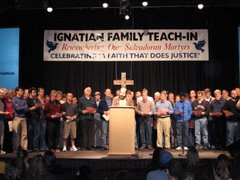
At his Palm Sunday homily, Pope Benedict issued a strong statement in opposition to the war in Iraq --- statements that should quell any Catholic's questions over the Church's position in this area.
"Pope Benedict XVI issued one of his strongest appeals for peace in Iraq on Sunday, days after the body of the kidnapped Chaldean Catholic archbishop was found near the northern city of Mosul. The pope also denounced the five-year-long war, saying it had provoked the complete breakup of Iraqi civilian life.
"Enough with the slaughters. Enough with the violence. Enough with the hatred in Iraq!"
Benedict said to applause at the end of his Palm Sunday Mass in St. Peter's Square.
On Thursday, the body of Archbishop Paulos Faraj Rahho was found near Mosul. He had been abducted on Feb. 29. Benedict has called Rahho's death an "inhuman act of violence" that offended human dignity. On Sunday, Benedict praised Rahho for his refusal to abandon his flock despite many threats and difficulties. Benedict said Rahho's dedication to the Catholic Church and his death compelled him to "raise a strong and sorrowful cry" to denounce the violence in Iraq spawned by the war that began five years ago this week.
We join with our Chaldean brothers and sisters in sorrow for the loss of their beloved shepherd, Archbishop Paulos Faraj Rahho. His witness to stay with his people is an especially strong symbol during this Holy Week --- and similar to another tremendous pastor who's assasination anniversary is on March 24, 1980, Archbishop Oscar Romero (El Salvador).
How much more do we need to see to draw connections between the violence and destruction of these two sacred yet war-torn countries?
Showing posts with label Iraq War. Show all posts
Showing posts with label Iraq War. Show all posts
Monday, March 17, 2008


Monday, December 10, 2007
December 2007 -- Actions for Peace
Peace on earth, End the war
December 21, 2007 ; 5:00-6:00PM
downtown Royal Oak
A Call for Peace This holiday season our nation is still at war, as it hasbeen the last four years. In this time of generosity of spirit, we mustcollectively stand up for peace as members of faith communities and peacegroups joining together. Our leaders must hear our message--we yearn forpeace. Unending war is not the way of the spirit. Sometimes we must lead ourleaders. Now is such a time. Join the Peace Walk You are invited to join the peace walk on Fri, Dec 21from 5-6PM in downtown Royal Oak , chosen for its central location. We willassemble at Royal Oak First United Methodist Church at 320 W. 7th Street,beginning at 4:30. We will start the one mile walk through downtown RoyalOak at 5:10PM. A map of the route is included. "Peace on earth, end the war"signs will be available to carry. The church will offer hot water for teaand cocoa and restrooms for our use.Coming together - our message is made even more powerful by communicatingthat many area groups and faith communities have come together for thispeace vigil. If your group has a banner or sign that identifies it, weencourage you to bring it.
Iraq Moratorium
This walk is being held in concert with the IraqMoratorium, a call initiated by United for Peace and Justice to end the warin Iraq. UPJ is a coalition of 1300 organizations nationwide. Theyencourage citizens to host events each month on the third Friday to focusAmerica on the need to end the war. This is our second Third Friday event.More will follow. If you would like to help plan the next one, pleasecontact our team at wethepeople2008@ gmail.com. Parking: At the church, on the street, and also, in the city parkingstructure on S. Lafayette between W. Fifth St. and W. Sixth St.Chuck Altman, Carol Christensen, Jeffrey Kolakowski, and Rev. Rich Peacock For More Information http://www.11hour4p eace.org/>and wethepeople@ gmail.com
This is being organized by the group "11th Hour for Peace" who vigil againstthe war every Saturday 11-11:30 at Rochester Road & Big Beaver.
Friday, April 13, 2007
Iraq: Catholic Resources for Discernment

Dear Companions in Jesuit Ministry,
Peace of Christ!
This is a traditional greeting on Jesuit letters, and it takes on special meaning in these days when our nation is struggling over how best to find an elusive peace in war-torn Iraq. We are all painfully aware of the great consequence and complexity of the current policy deliberations. They are not only political and military decisions, but moral and ethical ones as well. Our Catholic faith calls us to participation in the national debate, especially in its moral and ethical aspects. That call is not only to us individually but as community – whether that be family, neighborhood, parish, school, retreat house – and we write to encourage and perhaps facilitate further discussion and participation.
The search for reconciliation in Iraq and here at home over these frequently divisive issues will only bear fruit through thoughtful discernment and informed dialogue. Yet, complicated by politics and self-interested agendas, much of the current public discourse can be contradictory and confusing. Many of us struggle to sift through it all to find good and helpful material. As a contribution to our common effort at good citizenship, we would like to offer a series of collected materials from various sources that we think helpful . We encourage you to consider these materials individually and in community.
Perhaps you would want to ask yourselves these questions:
- Does this material and particularly its assumptions coincide with my own experience?
- What are the moral and ethical norms that underlie the argument? Are they applied appropriately?
- How is this helpful for my own understanding and my own discussion and action, however informal, regarding our national decisions regarding Iraq?
The first set in an ongoing series of materials is now available at www.jesuit.org/iraq.
We will provide other materials in the coming weeks. Any suggestions you might have for future materials would be welcome at outreach@jesuit.org. And we apologize if you have received these materials in multiple ways. We are trying to send it as widely as possible.
As Companions of Christ’s Mission, may we pray for guidance from the Spirit He has sent to be with us always.
James R. Stormes SJ
Secretary, Social and International Ministries
Jesuit Conference
Wednesday, February 28, 2007
JCSIM Statement on Iraq - February 2007
In early February 2007, the Jesuit Commission for Social and International Ministries (JCSIM), issued a statement in response to the call from President Bush about increasing military personnel in Iraq. It calls for greater efforts at a diplomatic response to the increasing violence rather than an increased number of US military personnel.
The name of the document is: "An Invitation to Persons of Good Will to Support Intensified Diplomacy Rather Than an Escalation of Military Force in Iraq". It was edited several times and signed by 8 of 9 members on the commission.
The full text appears below and copies of the statement will be sent out to each Jesuit community in the province with an invitation to take part in the 'actions' listed at the end. As the 4th anniversary of the US led invasion comes upon us on 19 March 2007, let us remember all those who are in need of our prayers and our actions for increased diplomacy. NOW is always the time to act for peace...
* * * * * * *
Statement by the Jesuit Commission for Social and International Ministries (JCSIM)
February 2007
An Invitation to Persons of Good Will to Support Intensified Diplomacy
Rather Than an Escalation of Military Force in Iraq
Prior to the outset of the Iraq War, members of the faith community expressed grave moral concerns about military intervention in Iraq and questioned whether the full consequences of such a war had been properly considered. Indeed, Bishop Wilton Gregory, speaking as the then President of the United States Conference of Catholic Bishops, wrote:
“We join with Pope John Paul in the conviction that war is not ‘inevitable’ and that ‘war is always a defeat for humanity’…Our bishops’ conference continues to question the moral legitimacy of any preemptive, unilateral use of military force to overthrow the government of Iraq... Based on the facts that are known, it is difficult to justify resort to war against Iraq, lacking clear and adequate evidence of an imminent attack of a grave nature or Iraq’s involvement in the terrorist attacks of September 11. With the Holy See and many religious leaders throughout the world, we believe that resort to war would not meet the strict conditions in Catholic teaching for the use of military force.”
Given how prescient the moral concerns expressed by faith leaders proved to be, it is imperative that faith leaders speak out now as the President moves to increase the number of troops committed to the war in Iraq. We, the undersigned members of the Jesuit Commission on Social and International Ministry, join with the United States Conference of Catholic Bishops, the Conference of Major Superiors of Men (CMSM), the Leadership Conference of Women Religious (LCWR), and other persons of faith to express concern over this escalation in military force and to encourage our President and Congress to embrace a policy of broader diplomatic engagement that will not only seek to restore security, stability and reconstruction in Iraq, but also to end the Israeli-Palestinian conflict and prevent the return of civil war in Lebanon. The destabilization of Iraq, caused by the United States invasion and subsequent management of the ensuing conflict, has added to the already complex tensions existing in the region. This makes it all the more imperative that the United States make a concerted diplomatic effort to engage all the governments in the Middle East in a common effort to find solutions to the tensions that now threaten to engulf the entire region in a conflagration with unimaginable consequences.
Already, the Iraq war has had devastating consequences:
The Iraqi Health Ministry reports that in 2006, 22,950 Iraqi civilians and police officers died violent deaths. In the first six months of last year, 5,640 Iraqi civilians and police officers were killed, but that number more than tripled to 17,310 in the latter half of the year.
Last year’s spike in casualties occurred despite an ambitious U.S. military operation in the capital, “Together Forward,” that involved thousands of U.S. and Iraqi troops cordoning off some of the deadliest neighborhoods in Baghdad and conducting house-to-house searches.
More than 3,000 members of the United States armed forces have died in the Iraq conflict with more than 20,000 soldiers injured since the start of the Iraq war.
The conflicts in Iraq and Afghanistan are now costing the United States government approximately $8 billion a month, $3,000 per second. This is in addition to the Defense Budget that in the last fiscal year was $463 billion dollars, or approximately $14,000 per second. There are calls now for increasing the size of the United States armed forces due to the strain experienced in fighting the wars in Iraq and Afghanistan. If approved, this increase will result in a further escalation in Pentagon spending. Defense spending, and the cost of military operations places real constraints on the ability of the United States to respond to the pressing social needs of the United States. It also limits the humanitarian and development assistance the United States is able to provide to other nations which would serve to stabilize nations and regions.
The U.N. High Commissioner for Refugees believes that 1.7 million Iraqis are displaced inside Iraq, whose prewar population was 21 million. The U.N. also reports that roughly 40 percent of Iraq’s middle class is believed to have fled the country; this in the wake of violence that has cost the lives of at least 2,000 Iraqi doctors since the U.S. invasion in 2003. The flight has undermined basic services such as water and sanitation and disrupted commerce, making it increasingly difficult for Iraqi society to function. Neighboring countries are being overwhelmed by the influx of Iraqi refugees. Iraqi refugees now account for 10 percent of the population of Jordan, a nation of only 6 million persons – the equivalent of 30 million landing on U.S. shores. The U.S. has been sluggish in its response to this crisis allowing only 466 Iraqis to immigrate under refugee status since 2003 and allocating only $20 million for Iraqi refugee assistance.
It is clear that the United States needs to engage with the international community, particularly all the nations which share borders with Iraq, in creating a process that would end the endemic violence in Iraq, reduce sectarian tensions, mobilize humanitarian relief and reconstruction aid, train Iraqi security forces, and allow for the phased withdrawal of United States combat forces.
We call upon all people of faith, all people of good will, to do the following:
To declare one Sabbath day each month as a day of prayer and fasting for a peaceful resolution to the conflict in Iraq, to acknowledge and begin to redress the suffering and violence endured daily by the Iraqi people, to remember the members of our armed forces who serve, and have served, in Iraq, and to petition that God grant comfort and peace to all who have lost loved ones in this conflict.
To write to President Bush and Secretary of State Condoleezza Rice asking them to engage the international community in a united effort to find a path to peace in Iraq and to exclude no nation from this effort. We ask them, as well, to work with the international community in resolving the Israeli-Palestinian conflict as well as in forestalling a renewed civil war in Lebanon.
To write to their representatives in Congress calling upon them to press the administration to engage in a broad, diplomatic effort to address not only the conflict in Iraq, but the conflicts now threatening the wider Middle East. We ask Congress, as well, to oppose the escalation of the conflict and to seek the means by which a phased withdrawal of forces can happen sooner rather than later.
The Iraq War has proven the truth that ‘war is a defeat for humanity.’ The human cost of this war has been devastating and that devastation continues daily. It is time for the United States to recognize that a change in course in Iraq is required; not an increase in troops and attendant violence, but an increase in diplomatic efforts to engage all parties in the region in helping the Iraqi people to live together in peace.
Signed:
Mary Baudouin
Assistant for Social Ministries
New Orleans Province
Kevin Cullen, S.J.
Assistant for Social and International Ministries
Missouri Province
Mark Hallinan, S.J.
Assistant for Social Ministries
New York Province
Timothy Kelly
Assistant for Social and International Ministries
Maryland Province
Carrie Monnette
Assistant for Social and International Ministries
Detroit Province
Mark Potter
Assistant for Social Ministries
California Province
John Sealey
Assistant for Social and International Ministries
Wisconsin Province
William Watson, S.J.
Special Assistant for International Ministries
Oregon Province
Contacts to express your position:
The Honorable George W. Bush
President of the United States
The White House
Washington, DC 20500
202-456-1111 (comment line)
202-456-2461 (fax)
president@whitehouse.gov
The Honorable Condoleezza Rice
Secretary of State
Department of State
2201 C Street NW
Washington DC 20520
202-647-6575
202-647-2283 (fax)
http://www.state.gov/
Links to congressional representatives
202-224-3121 (Capitol Switchboard)
http://www.house.gov/
http://www.sentate.gov/
The name of the document is: "An Invitation to Persons of Good Will to Support Intensified Diplomacy Rather Than an Escalation of Military Force in Iraq". It was edited several times and signed by 8 of 9 members on the commission.
The full text appears below and copies of the statement will be sent out to each Jesuit community in the province with an invitation to take part in the 'actions' listed at the end. As the 4th anniversary of the US led invasion comes upon us on 19 March 2007, let us remember all those who are in need of our prayers and our actions for increased diplomacy. NOW is always the time to act for peace...
* * * * * * *
Statement by the Jesuit Commission for Social and International Ministries (JCSIM)
February 2007
An Invitation to Persons of Good Will to Support Intensified Diplomacy
Rather Than an Escalation of Military Force in Iraq
Prior to the outset of the Iraq War, members of the faith community expressed grave moral concerns about military intervention in Iraq and questioned whether the full consequences of such a war had been properly considered. Indeed, Bishop Wilton Gregory, speaking as the then President of the United States Conference of Catholic Bishops, wrote:
“We join with Pope John Paul in the conviction that war is not ‘inevitable’ and that ‘war is always a defeat for humanity’…Our bishops’ conference continues to question the moral legitimacy of any preemptive, unilateral use of military force to overthrow the government of Iraq... Based on the facts that are known, it is difficult to justify resort to war against Iraq, lacking clear and adequate evidence of an imminent attack of a grave nature or Iraq’s involvement in the terrorist attacks of September 11. With the Holy See and many religious leaders throughout the world, we believe that resort to war would not meet the strict conditions in Catholic teaching for the use of military force.”
Given how prescient the moral concerns expressed by faith leaders proved to be, it is imperative that faith leaders speak out now as the President moves to increase the number of troops committed to the war in Iraq. We, the undersigned members of the Jesuit Commission on Social and International Ministry, join with the United States Conference of Catholic Bishops, the Conference of Major Superiors of Men (CMSM), the Leadership Conference of Women Religious (LCWR), and other persons of faith to express concern over this escalation in military force and to encourage our President and Congress to embrace a policy of broader diplomatic engagement that will not only seek to restore security, stability and reconstruction in Iraq, but also to end the Israeli-Palestinian conflict and prevent the return of civil war in Lebanon. The destabilization of Iraq, caused by the United States invasion and subsequent management of the ensuing conflict, has added to the already complex tensions existing in the region. This makes it all the more imperative that the United States make a concerted diplomatic effort to engage all the governments in the Middle East in a common effort to find solutions to the tensions that now threaten to engulf the entire region in a conflagration with unimaginable consequences.
Already, the Iraq war has had devastating consequences:
The Iraqi Health Ministry reports that in 2006, 22,950 Iraqi civilians and police officers died violent deaths. In the first six months of last year, 5,640 Iraqi civilians and police officers were killed, but that number more than tripled to 17,310 in the latter half of the year.
Last year’s spike in casualties occurred despite an ambitious U.S. military operation in the capital, “Together Forward,” that involved thousands of U.S. and Iraqi troops cordoning off some of the deadliest neighborhoods in Baghdad and conducting house-to-house searches.
More than 3,000 members of the United States armed forces have died in the Iraq conflict with more than 20,000 soldiers injured since the start of the Iraq war.
The conflicts in Iraq and Afghanistan are now costing the United States government approximately $8 billion a month, $3,000 per second. This is in addition to the Defense Budget that in the last fiscal year was $463 billion dollars, or approximately $14,000 per second. There are calls now for increasing the size of the United States armed forces due to the strain experienced in fighting the wars in Iraq and Afghanistan. If approved, this increase will result in a further escalation in Pentagon spending. Defense spending, and the cost of military operations places real constraints on the ability of the United States to respond to the pressing social needs of the United States. It also limits the humanitarian and development assistance the United States is able to provide to other nations which would serve to stabilize nations and regions.
The U.N. High Commissioner for Refugees believes that 1.7 million Iraqis are displaced inside Iraq, whose prewar population was 21 million. The U.N. also reports that roughly 40 percent of Iraq’s middle class is believed to have fled the country; this in the wake of violence that has cost the lives of at least 2,000 Iraqi doctors since the U.S. invasion in 2003. The flight has undermined basic services such as water and sanitation and disrupted commerce, making it increasingly difficult for Iraqi society to function. Neighboring countries are being overwhelmed by the influx of Iraqi refugees. Iraqi refugees now account for 10 percent of the population of Jordan, a nation of only 6 million persons – the equivalent of 30 million landing on U.S. shores. The U.S. has been sluggish in its response to this crisis allowing only 466 Iraqis to immigrate under refugee status since 2003 and allocating only $20 million for Iraqi refugee assistance.
It is clear that the United States needs to engage with the international community, particularly all the nations which share borders with Iraq, in creating a process that would end the endemic violence in Iraq, reduce sectarian tensions, mobilize humanitarian relief and reconstruction aid, train Iraqi security forces, and allow for the phased withdrawal of United States combat forces.
We call upon all people of faith, all people of good will, to do the following:
To declare one Sabbath day each month as a day of prayer and fasting for a peaceful resolution to the conflict in Iraq, to acknowledge and begin to redress the suffering and violence endured daily by the Iraqi people, to remember the members of our armed forces who serve, and have served, in Iraq, and to petition that God grant comfort and peace to all who have lost loved ones in this conflict.
To write to President Bush and Secretary of State Condoleezza Rice asking them to engage the international community in a united effort to find a path to peace in Iraq and to exclude no nation from this effort. We ask them, as well, to work with the international community in resolving the Israeli-Palestinian conflict as well as in forestalling a renewed civil war in Lebanon.
To write to their representatives in Congress calling upon them to press the administration to engage in a broad, diplomatic effort to address not only the conflict in Iraq, but the conflicts now threatening the wider Middle East. We ask Congress, as well, to oppose the escalation of the conflict and to seek the means by which a phased withdrawal of forces can happen sooner rather than later.
The Iraq War has proven the truth that ‘war is a defeat for humanity.’ The human cost of this war has been devastating and that devastation continues daily. It is time for the United States to recognize that a change in course in Iraq is required; not an increase in troops and attendant violence, but an increase in diplomatic efforts to engage all parties in the region in helping the Iraqi people to live together in peace.
Signed:
Mary Baudouin
Assistant for Social Ministries
New Orleans Province
Kevin Cullen, S.J.
Assistant for Social and International Ministries
Missouri Province
Mark Hallinan, S.J.
Assistant for Social Ministries
New York Province
Timothy Kelly
Assistant for Social and International Ministries
Maryland Province
Carrie Monnette
Assistant for Social and International Ministries
Detroit Province
Mark Potter
Assistant for Social Ministries
California Province
John Sealey
Assistant for Social and International Ministries
Wisconsin Province
William Watson, S.J.
Special Assistant for International Ministries
Oregon Province
Contacts to express your position:
The Honorable George W. Bush
President of the United States
The White House
Washington, DC 20500
202-456-1111 (comment line)
202-456-2461 (fax)
president@whitehouse.gov
The Honorable Condoleezza Rice
Secretary of State
Department of State
2201 C Street NW
Washington DC 20520
202-647-6575
202-647-2283 (fax)
http://www.state.gov/
Links to congressional representatives
202-224-3121 (Capitol Switchboard)
http://www.house.gov/
http://www.sentate.gov/
Thursday, January 11, 2007
President calls for more troops in Iraq

Today, January 11, 2007, President Bush traveled to Ft. Benning, GA in Columbus, GA in order to promote his new 'plan' to increase US troops in Iraq by over 20,000. This site is a familiar one to the Ignatian family as it is the site of the Western Hemisphere Institute for Security Cooperation (WHINSEC), formerly known as the School of the America, SOA. It is known for training military personnel from foreign countries in tactics that have caused severe human rights abuses. Is it a coincidence that this location, home of the annual Ignatian Family Teach-In in November, is now a symbolic pulpit for this administration to begin another military action? Where are we turning a blind-eye to the human rights issues (ie. civilian killings, torture, oppressive military presence) in Iraq that were made known to us graphically in the 80's and early 90's in El Salvador?
To read the President's full speech on Wednesday, January 10, 2007 about the 'troop increase' to Iraq, following the following link: http://www.npr.org/templates/story/story.php?storyId=6803354
Subscribe to:
Posts (Atom)
+of+IMG_1549.JPG)